Warning Signs
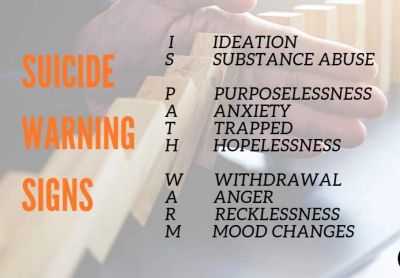
Behavioral changes - Changes in actions and daily habits
- Withdrawing from friends, family, and social activities
- Giving away meaningful personal possessions
- Saying goodbye as if it's for the last time
- Researching methods of suicide online
- Increased use of alcohol or drugs
- Reckless or self-destructive behavior
- Sudden calmness after a period of deep depression
- Skipping school, work, or commitments they once cared about
- Putting personal affairs in order — making a will, finalizing things
Emotional signs—Shifts in feelings and inner state
- Expressing feelings of hopelessness or having no reason to live
- Feeling like a burden to others
- Extreme mood swings — from very low to suddenly at peace
- Prolonged sadness, crying, or emotional numbness
- Feeling trapped with no way out
- Intense anxiety, agitation, or anger
- A deep sense of shame, guilt, or self-hatred
- Loss of interest in things they once loved
Verbal and written warning signs— What they say or write
- "I wish I were dead" or "I want to kill myself"
- "Everyone would be better off without me"
- "I won't be a problem much longer"
- "There's no point in anything anymore"
- "I just want it all to stop"
- Writing, posting, or texting about death, dying, or suicide
- Dark or hopeless themes in journals, art, or social media posts
- Saying final goodbyes or expressing gratitude as if wrapping up
Social and relational signs—Changes in relationships and connection
- Cutting off close friends or romantic partners without explanation
- Avoiding texts, calls, or social media after previously being active
- Expressing that no one understands or cares about them
- Feeling disconnected or like a stranger to their own life
- Unusual and unexpected reconnecting with old friends or family
- Canceling plans and declining invitations consistently
Physical and health signs—Changes in body and health habits
- Neglecting personal hygiene, appearance, or basic self-care
- Significant changes in sleep — too much or not sleeping at all
- Major appetite changes or unexplained weight loss or gain
- Fatigue and low energy that doesn't improve
- Evidence of self-harm (cuts, burns, or bruising)
- Stockpiling medications or seeking access to weapons
If You Are In Crisis Right Now
Crisis Text Line
The Trevor Project

If calling feels too hard, text HOME to 741741 to connect with a trained crisis counselor via text message. Available 24/7, completely free, and confidential. A good option for young adults who are more comfortable texting than talking.
Text - Text HOME to 741741
Chatcrisistextline.org
The Trevor Project
The Trevor Project
The Trevor Project provides 24/7 crisis intervention and suicide prevention specifically for LGBTQ+ young people. Crisis counselors are trained in identity-affirming support and understand the unique challenges LGBTQ+ young people face.
Call 1-866-488-7386.
Text - Text START to 678-678
ChatTheTrevorProject.org
988 Crisis Line
988 Crisis Line

The 988 Suicide & Crisis Lifeline connects you to a trained, caring crisis counselor in minutes — 24 hours a day, 7 days a week, every day of the year. You can call, text, or chat. Your conversation is free and confidential. There is no reason too big or too small to reach out.
Call 988
Text 988
For Parents, Friends and Family

What to do when you're scared for someone you love
Most people who visit a suicide prevention website aren't in crisis themselves—they're terrified about someone else. If that's you, this section is for you. Here is what to do, step by step.
Don't wait and hope it passes
If you have a gut feeling something is wrong, trust it. Waiting to see if it gets better on its own is the most common mistake families make. Act now, not later.
Ask them directly
Research consistently shows that asking someone directly about suicide does not plant the idea—it opens a door and often brings relief. Use clear, direct language.
Listen without fixing
Your job in this moment is not to solve the problem. It is to make them feel heard, not judged, and not alone. Resist the urge to offer quick reassurances or solutions.
Stay with them
If you believe someone is in immediate danger, do not leave them alone. Remove access to firearms or medications if you can do so safely.
Connect them to help
Offer to call 988 with them or sit with them while they text. Offer to drive them to a counselor. Make the path to help as easy as possible.
Follow up
After a crisis moment passes, the risk does not disappear. Check in the next day and the day after. Sustained connection is one of the strongest protective factors known.
Risk factors
Mental health history - The most significant individual risk factor
Trauma and adverse experiences - Past wounds that increase present risk
Mental health history - The most significant individual risk factor
Mental health conditions — especially depression, anxiety, bipolar disorder, schizophrenia, and borderline personality disorder — are among the strongest predictors of suicide risk. However, nearly half of people who die by suicide had no known diagnosis at the time of death, which is why awareness matters for everyone, not just those already in treatment. (CDC, SAMSHA 2024)
Substance use - Alcohol, drugs, and suicide risk
Trauma and adverse experiences - Past wounds that increase present risk
Mental health history - The most significant individual risk factor
Substance use — including alcohol, marijuana, opioids, and other drugs — significantly raises suicide risk. Substances lower inhibition, impair judgment, increase impulsivity, and worsen depression and anxiety. Young adults are the age group most likely to develop substance use disorders, making this intersection especially dangerous for this population. (SAMSHA 2024)
Trauma and adverse experiences - Past wounds that increase present risk
Trauma and adverse experiences - Past wounds that increase present risk
Trauma and adverse experiences - Past wounds that increase present risk
Experiencing trauma — including childhood abuse or neglect, sexual assault, domestic violence, community violence, bullying, or other adverse childhood experiences (ACEs) — significantly elevates suicide risk. Trauma can alter how young people see themselves and the world, making hopelessness more likely and recovery harder without proper support.
Social isolation - Disconnection as a silent danger
Access to lethal means - Availability dramatically affects outcomes
Trauma and adverse experiences - Past wounds that increase present risk
Feeling cut off from others — whether from family conflict, loss of relationships, moving away from home, or simply feeling unseen — is one of the most consistent predictors of suicide risk across all research. For young adults navigating college, early careers, and major life transitions, isolation can develop quickly and silently. Social media connection is not the same as genuine human belonging. (CDC, SAMSHA 2024, AFSP)
LGBTQ+ youth - A population facing dramatically elevated risk
Access to lethal means - Availability dramatically affects outcomes
Access to lethal means - Availability dramatically affects outcomes
LGBTQ+ young people face significantly higher rates of suicidal thoughts and attempts than their peers — not because of who they are, but because of the rejection, discrimination, bullying, and lack of acceptance many face. Family rejection and lack of affirming support are the most powerful drivers of this elevated risk. Acceptance saves lives.
Access to lethal means - Availability dramatically affects outcomes
Access to lethal means - Availability dramatically affects outcomes
Access to lethal means - Availability dramatically affects outcomes
Access to firearms and other lethal means is one of the most critical and preventable risk factors. Most people who survive a suicide attempt do not go on to die by suicide — but the lethality of the method used determines whether someone survives. Reducing access to lethal means during a crisis — especially firearms — saves lives. (CDC 2024)
Protective factors
Protective factors
Access to mental health care
Connection to family
Protective factors don't eliminate risk — but they can significantly reduce it. These are the things that build resilience and make it more likely someone will reach out for help instead of acting on suicidal thoughts.
Connection to family
Access to mental health care
Connection to family
Connection to family- Supportive, accepting family relationships are among the strongest protective factors.
Access to mental health care
Access to mental health care
Access to mental health care
SAMHSA Treatment Locator
Free federal tool to find local behavioral health treatment services, including low-cost and no-cost options.
findtreatment.gov
Psychology Today Therapist Finder
Search by ZIP code, insurance, specialty (including depression, trauma, LGBTQ+), and sliding scale fees.
psychologytoday.com/us/therapists
Problem-solving skills
Positive peer relationships
Access to mental health care
Problem-solving skills -Coping tools and emotional regulation reduce the likelihood of crisis escalation
Positive peer relationships
Positive peer relationships
Positive peer relationships
Positive peer relationships—Even one trusted person can be the difference in a moment of crisis.
Safe, stable environment
Positive peer relationships
Positive peer relationships
Safe, stable environment—Reduced exposure to violence, abuse, and chaos lowers baseline risk.
Stats/Facts

CDC - Key facts
- Suicide was among the top 8 leading causes of death for ages 10–64 in 2023
- Suicide rates among youth ages 10–24 increased 52% between 2000 and 2021
- Youth and young adults account for 15% of all suicides
- There were an estimated 224,341 emergency department visits for self-harm among youth and young adults
- Firearms are the most common method — used in 57% of all suicides in 2024, the highest proportion ever recorded
- The suicide rate among males is approximately 4 times higher than among females
SAMHSA - 2024 national survey findings
- In 2024, 5.5% of all adults (14.3 million) had serious thoughts of suicide
- Young adults 18–25 had the highest rate of serious suicidal thoughts of any adult age group at 12.6%
- Adults who made a suicide plan increased from 1.4% in 2021 to 1.8% in 2024
- Only 11.3% of young adults who needed substance use treatment received it — the lowest rate of any age group
- Among young adults with a mental illness, nearly 50% did not receive treatment
CDC- Groups facing higher risk
- LGBTQ+ young people: 39% seriously considered suicide and 12% attempted it in the past year
- Rural youth ages 15–19 have a suicide rate of 15.8 per 100,000 — compared to 9.1 in urban areas
- Black young adults ages 20–24 now have higher suicide rates than their white peers for the first time
- Veterans under 45: suicide is the second leading cause of death
- About half of all people who die by suicide had no known diagnosed mental health condition at the time of death
CDC - The iceberg beneath every death
- For every suicide death, there are approximately 27 attempts
- For every suicide death, approximately 135 people are exposed to that loss and affected by it
- Suicide and nonfatal self-harm cost the nation over $500 billion in 2020 alone
- About 49% of people who die by suicide had a known diagnosed mental health condition
- Since the 988 Lifeline launched in 2022, it has received more than 19 million calls, texts, and chats
AFSP Additional statistics
- In 2023, an estimated 12.8 million adults seriously thought about suicide
- 9% of high school students (grades 9–12) attempted suicide at least once in the past 12 months
- Men died by suicide 3.8 times more than women in 2023
- White males accounted for 68% of suicide deaths in 2023
- Non-Hispanic American Indian and Alaska Native people have the highest suicide death rates of any racial or ethnic group